 Kingtide
Train around it: knee
How to keep lifting with knee pain.
 By Kayiita Johansson, founder. Last updated .
You can usually keep training with a sore knee by changing what you do rather than stopping everything. For patellofemoral pain and knee osteoarthritis, exercise is a recommended treatment, not something to avoid. Ease off the movements that aggravate the knee, keep the rest of your session, and build back gradually.
Get it checked first if the knee locks, gives way, swells badly or won't take your weight.
Get it checked first
The NHS says to get urgent advice (NHS 111 in the UK) if:
- your knee is very painful
- you can't move your knee or put any weight on it
- your knee is badly swollen or has changed shape
- your knee locks, gives way or painfully clicks (painless clicking is normal)
- you have a very high temperature, or feel hot, cold or shivery, with redness or heat around the knee, which can be a sign of infection
See a doctor if knee pain hasn't improved within a few weeks. Source: NHS, Knee pain.
The principles
A fresh flare: take the weight off first
For new knee pain, the NHS's first advice is to put as little weight as possible on the knee, use an ice pack for up to 20 minutes every 2 to 3 hours, and expect to feel better in a few days (NHS). Your upper-body sessions don't need the knee.
Pain that hangs around: keep moving
For knee osteoarthritis, the NHS calls exercise one of the most important treatments, and warns that not using your joints can cause your muscles to waste (NHS). Patellofemoral pain is pain under or around the kneecap that typically gets worse when you squat or climb stairs (Cleveland Clinic). For it, a 2016 international consensus statement recommends exercise therapy to reduce pain, and recommends combining hip and knee exercises over knee exercises alone (Crossley et al., British Journal of Sports Medicine).
Change the movement, not the whole plan
Cleveland Clinic's advice for patellofemoral pain is that you may have to change how you train, or tweak your form for running, jumping or squatting (Cleveland Clinic). The upper-body work, the core work and whatever else doesn't bother the knee can stay as it is.
Build back gradually
The NHS also warns that too much exercise too quickly, or the wrong sort, may damage your joints (NHS). The AAOS knee conditioning program says you should not feel pain during an exercise, and to talk to your doctor or physical therapist if you do (AAOS OrthoInfo).
Example swaps
These are common options, not a prescription. The exercises on the right all appear in the AAOS knee conditioning program. Which ones suit your knee is a question for your doctor or physio.
| If this aggravates it | Options to ask about |
|---|---|
| Deep squats | Half squats, or a leg press |
| Lunges and jumps | Straight-leg raises, hamstring curls, calf raises |
| Running to warm up | Walking or a stationary bike, the warm-up AAOS suggests |
| Knee-only rehab work | Add hip work, such as hip abduction, in line with the consensus advice above |
How Kingtide handles a sore knee
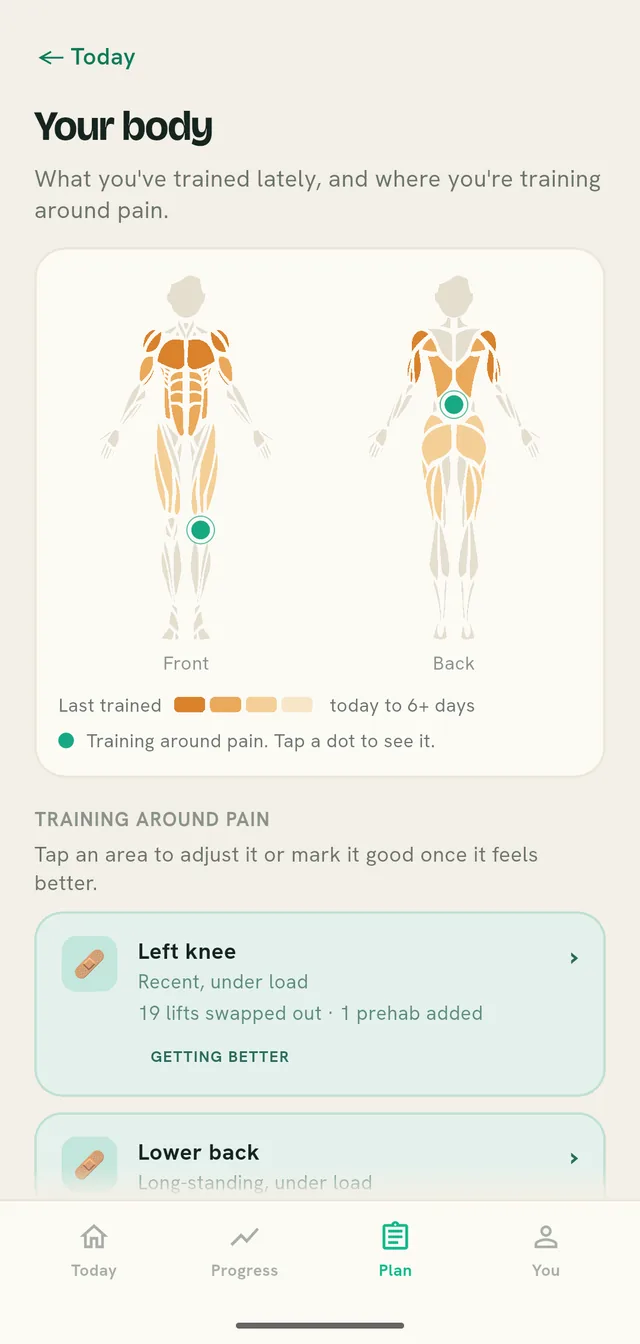
Mark the knee on the body map and say how it feels. Kingtide swaps the movements that aggravate it for ones that don't, and leaves the rest of your session alone. Every change comes with its reason, and you can accept it, keep the lift, or swap it for something else.
The knee stays protected while it needs it. Then lighter work comes back, tracked set by set, and then your normal load. If a physio gave you an exercise sheet, photograph it and those exercises are built into your week. Get the app, or read the FAQ first.
Questions
Should I stop lifting if my knee hurts?
Not usually. For patellofemoral pain and knee osteoarthritis, exercise is a recommended treatment. Change or drop the movements that aggravate the knee and keep the rest of your session. Get it checked first if the knee locks, gives way, swells badly or won't take your weight.
Can I squat with knee pain?
The AAOS knee conditioning program includes half squats and leg presses, and says you should not feel pain during an exercise. If a full squat hurts, a shorter range or a different lower-body exercise is a common option. Ask a doctor or physio what fits your knee.
How does Kingtide help with knee pain?
Mark the knee on the body map and say how it feels. Kingtide swaps the movements that aggravate it, keeps the rest of your session, tells you why it changed each one, and walks you back to your normal load as the knee settles. Kingtide is not medical advice.
Sources
- NHS. Knee pain. www.nhs.uk/conditions/knee-pain/
- NHS. Osteoarthritis: treatment. www.nhs.uk/conditions/osteoarthritis/treatment/
- AAOS OrthoInfo. Knee conditioning program. www.orthoinfo.org/en/recovery/knee-conditioning-program/
- Cleveland Clinic. Patellofemoral pain syndrome (PFPS). my.clevelandclinic.org/health/diseases/17914-patellofemoral-pain-syndrome-pfps
- Crossley KM et al. 2016 Patellofemoral pain consensus statement, part 2: recommended physical interventions. Br J Sports Med 2016;50(14):844-52. pmc.ncbi.nlm.nih.gov/articles/PMC4975825/
No account, no sign-up, no email address. On iPhone and Android.
Get the app