 Kingtide
Train around it: shoulder
How to keep lifting with shoulder pain.
 By Kayiita Johansson, founder. Last updated .
With a sore shoulder you can usually keep training the rest of your body while the shoulder itself gets gentler, specific work. The NHS advises keeping the shoulder moving rather than stopping using it, avoiding what makes it worse, and not improvising strenuous exercises or heavy gym work for it. For subacromial shoulder pain, research reviews recommend exercise therapy as the first-line treatment.
Get it checked first if you can't move your arm, it changed shape, or the pain started after a fall.
Get it checked first
Call 999 (911 in the US) if you have chest pain that's spreading to your arms, neck or jaw, or chest pain that feels tight or like squeezing. Those are heart attack symptoms, not a training problem (NHS, Heart attack).
The NHS says to get an urgent appointment (NHS 111 in the UK) if:
- you have sudden or very bad shoulder pain
- you can't move your arm
- your arm or shoulder has changed shape or is badly swollen
- you have pins and needles that don't go away, or no feeling in your arm or shoulder
- your arm or shoulder is hot or cold to touch
- the pain started after an injury or accident, like a fall
- you develop severe pain in both shoulders, or feel feverish or unwell
See a doctor if the pain is getting worse or hasn't improved after 2 weeks, or it's very difficult to move your arm or shoulder. Source: NHS, Shoulder pain.
The principles
Keep the shoulder moving
The NHS advises staying active and gently moving your shoulder, and warns that completely stopping using it can stop it getting better. It also says to avoid things that seem to make it worse, and not to make up your own strenuous exercises or use heavy gym equipment for it (NHS). So the sore shoulder gets gentle, specific work, ideally from a physio, and the rest of your session carries on.
Exercise is the first-line treatment
A 2020 umbrella review of 16 systematic reviews made a strong recommendation for exercise therapy as the first-line treatment for subacromial shoulder pain, to improve pain, mobility and function. It also said more research is needed on the type and dose of exercise (Pieters et al., JOSPT). The NHS suggests shoulder exercises for 6 to 8 weeks to stop pain returning (NHS).
Overhead work is the usual suspect
The AAOS lists people who do repetitive lifting or overhead activities among those at risk of shoulder impingement, and says a doctor may suggest rest and activity changes, such as avoiding the overhead activities that cause your symptoms (AAOS OrthoInfo).
Give it time
The NHS says you usually need about 2 weeks of looking after it before shoulder pain starts to ease, and that recovery can take 6 months or longer (NHS). The AAOS says shoulder impingement typically takes 2 to 4 months for complete relief of pain, and can take up to a year (AAOS OrthoInfo). Plan around months, not one session.
Example swaps
These are common options, not a prescription. The exercises named here appear in the AAOS rotator cuff and shoulder conditioning program, which says you should not feel pain during an exercise. Which suit your shoulder is a question for your doctor or physio.
| If this aggravates it | Options to ask about |
|---|---|
| Overhead pressing | Leave it out while it causes symptoms, as AAOS suggests |
| Heavy pressing or pulling with the sore side | Lighter, specific shoulder work, such as standing rows with an elastic band, scapula setting and external rotation |
| Your usual upper-body warm-up | Walking or a stationary bike, then the pendulum and crossover arm stretch |
How Kingtide handles a sore shoulder
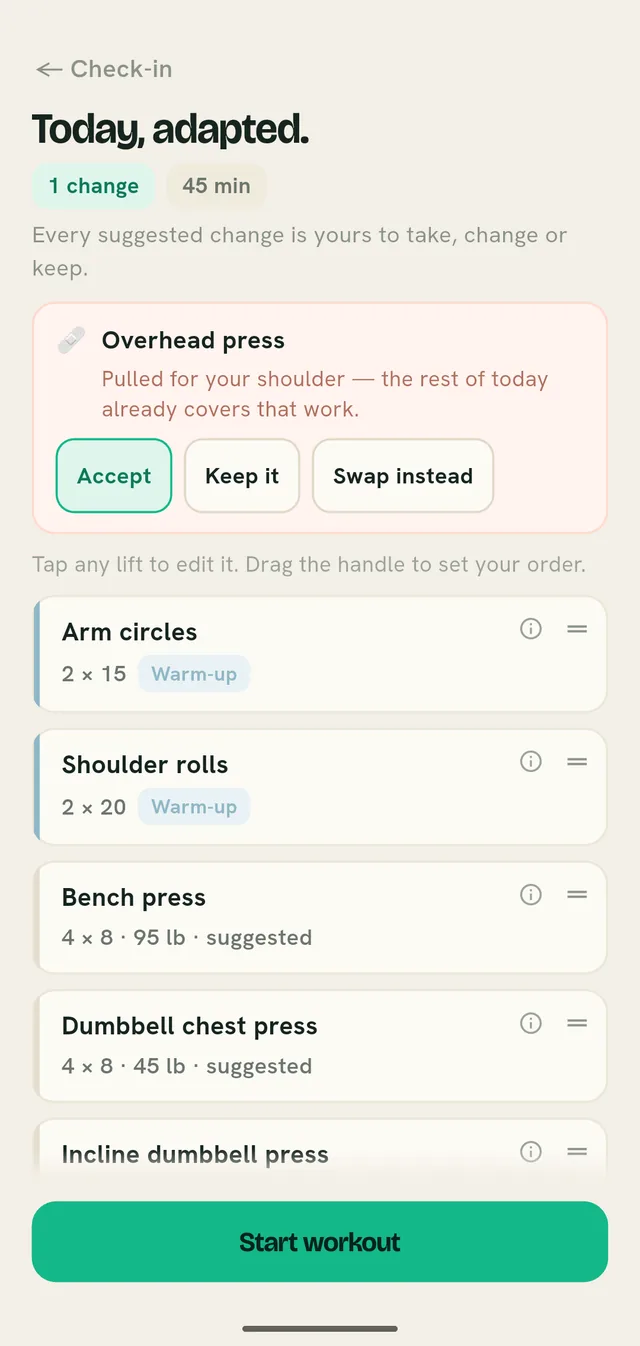
Mark the shoulder on the body map and say how it feels. Kingtide swaps the movements that aggravate it for ones that don't, and leaves the rest of your session alone. Every change comes with its reason, and you can accept it, keep the lift, or swap it for something else.
The shoulder stays protected while it needs it. Then lighter work comes back, tracked set by set, and then your normal load. If a physio gave you an exercise sheet, photograph it and those exercises are built into your week. Get the app, or read the FAQ first.
Questions
Should I stop lifting with shoulder pain?
Not completely. The NHS advises keeping the shoulder moving, avoiding things that make it worse, and not making up your own strenuous exercises or using heavy gym equipment for it. Train the rest of your body, give the shoulder the specific exercises a physio suggests, and get it checked if it isn't improving after 2 weeks.
Should I stop overhead pressing with a sore shoulder?
Often, for a while. The AAOS says a doctor may suggest avoiding the overhead activities that cause your symptoms, and its shoulder program says you should not feel pain during an exercise. Ask a doctor or physio when and how to bring it back.
How does Kingtide help with shoulder pain?
Mark the shoulder on the body map and say how it feels. Kingtide swaps the movements that aggravate it, keeps the rest of your session, tells you why it changed each one, and walks you back to your normal load as the shoulder settles. Kingtide is not medical advice.
Sources
- NHS. Shoulder pain. www.nhs.uk/conditions/shoulder-pain/
- NHS. Heart attack. www.nhs.uk/conditions/heart-attack/
- AAOS OrthoInfo. Shoulder impingement/rotator cuff tendinitis. www.orthoinfo.org/en/diseases--conditions/shoulder-impingementrotator-cuff-tendinitis/
- AAOS OrthoInfo. Rotator cuff and shoulder conditioning program. www.orthoinfo.org/en/recovery/rotator-cuff-and-shoulder-conditioning-program/
- Pieters L et al. An update of systematic reviews examining the effectiveness of conservative physical therapy interventions for subacromial shoulder pain. J Orthop Sports Phys Ther 2020;50(3):131-141. pubmed.ncbi.nlm.nih.gov/31726927/
No account, no sign-up, no email address. On iPhone and Android.
Get the app