 Kingtide
Train around it: lower back
How to keep lifting with lower back pain.
 By Kayiita Johansson, founder. Last updated .
You can usually keep training with lower back pain if you change the lifts that aggravate it. The NHS says back pain usually improves within a few weeks and advises staying active rather than resting in bed, and a Cochrane review found exercise is probably effective for reducing chronic low back pain.
Some symptoms need a doctor today, before any training. They're listed first below.
Get help first
The NHS says to call 999 or go to A&E (call 911 or go to the ER in the US) if you have back pain and:
- pain, tingling, weakness or numbness in both legs
- a loss of feeling around your genitals or anus
- changes in your bladder or bowels, such as difficulty peeing, or peeing or pooing yourself
- it started after a serious accident, such as a car accident
Get an urgent appointment if you feel hot, cold, shivery or generally unwell, or the pain is severe and started suddenly or is getting worse quickly. See a doctor if it hasn't improved after a few weeks of home treatment, you've lost weight without trying, or the pain doesn't improve after resting or is worse at night. Source: NHS, Back pain. Cleveland Clinic's list also includes fever, light-headedness or fainting, and severe abdominal pain, and says to get treatment as soon as possible if the pain is severe or follows a fall (Cleveland Clinic).
The principles
Stay active
The NHS advises staying active and carrying on with your daily activities, and not staying in bed for long periods (NHS). The UK's NICE guideline for low back pain includes encouragement to continue with normal activities, and suggests a group exercise programme for a flare-up (NICE NG59).
Exercise helps, modestly
A 2021 Cochrane review of 249 trials found moderate-certainty evidence that exercise is probably effective for chronic low back pain compared with no treatment, usual care or placebo. The effect on pain was clinically important; the effect on day-to-day function was small (Hayden et al., Cochrane). That review covers pain lasting over 12 weeks, not a flare from last Tuesday.
Change the lift that hurts, keep the rest
The NHS lists specific exercises and stretches for back pain, and says to stop if your pain gets worse and see a doctor (NHS). In the gym, that means the lift that aggravates your back is the one to change: less load, a shorter range, or a different exercise. The upper body, the core work that doesn't bother it and your conditioning can stay. If the pain gets worse, that's the NHS's signal to stop and get it looked at.
Example swaps
These are common options, not a prescription. The ones on the right come from NHS pages: general activities from the national NHS page, and named mobility exercises from a Cambridge University Hospitals NHS leaflet. Which suit your back is a question for your doctor or physio.
| In place of | Options to ask about |
|---|---|
| Conditioning that jars your back | Walking or swimming, which the NHS says may help ease back pain |
| Your usual warm-up | Knee hugs, knee rolls, pelvic tilts and bridging, from the Cambridge leaflet |
| A session you can't face | Yoga or pilates, which the NHS also lists |
How Kingtide handles a sore back
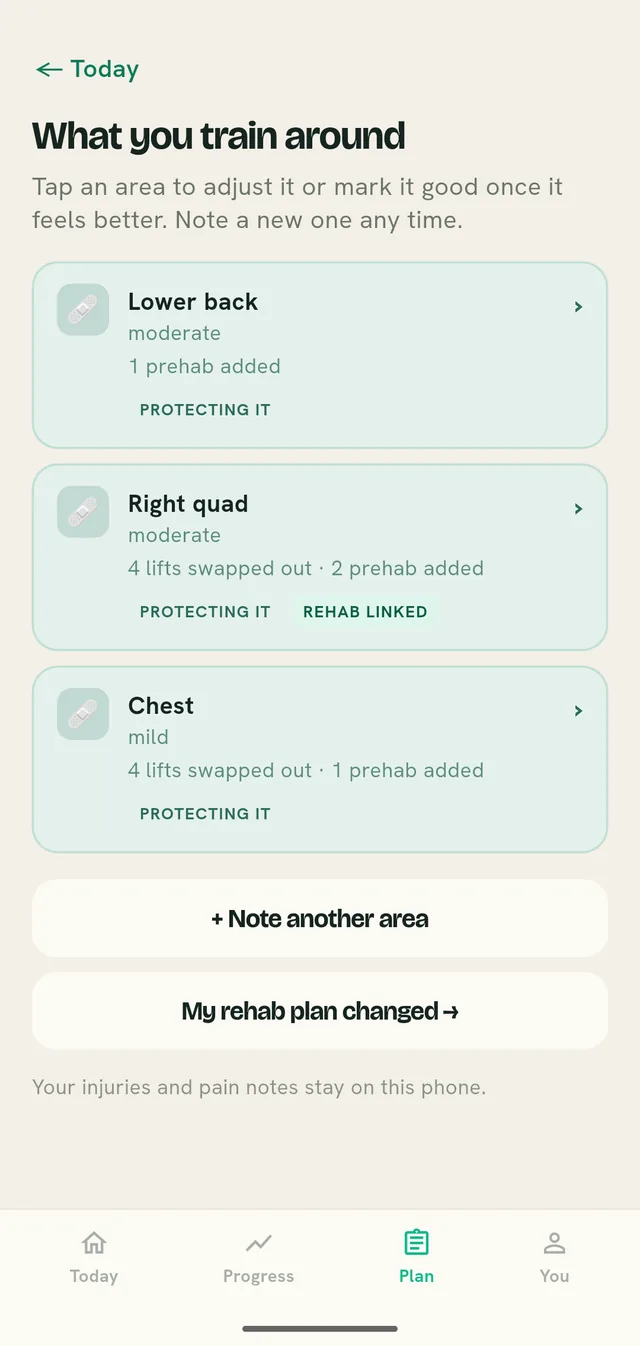
Mark your lower back on the body map and say how it feels. Kingtide swaps the movements that aggravate it for ones that don't, and leaves the rest of your session alone. Every change comes with its reason, and you can accept it, keep the lift, or swap it for something else.
Your back stays protected while it needs it. Then lighter work comes back, tracked set by set, and then your normal load. If a physio gave you an exercise sheet, photograph it and those exercises are built into your week. Get the app, or read the FAQ first.
Questions
Should I stop lifting with lower back pain?
Not usually. The NHS advises staying active and not staying in bed for long periods, and a Cochrane review found exercise is probably effective for chronic low back pain. Change the lifts that aggravate it and keep the rest. Stop and see a doctor if the pain gets worse.
When is lower back pain an emergency?
The NHS says to call 999 or go to A&E if you have back pain with pain, tingling, weakness or numbness in both legs, loss of feeling around your genitals or anus, changes in your bladder or bowels, or if it started after a serious accident. In the US, call 911 or go to the ER.
How does Kingtide help with lower back pain?
Mark your lower back on the body map and say how it feels. Kingtide swaps the movements that aggravate it, keeps the rest of your session, tells you why it changed each one, and walks you back to your normal load as it settles. Kingtide is not medical advice.
Sources
- NHS. Back pain. www.nhs.uk/conditions/back-pain/
- Cleveland Clinic. Lower back pain. my.clevelandclinic.org/health/diseases/7936-lower-back-pain
- NICE. Low back pain and sciatica in over 16s: assessment and management (NG59), recommendations. www.nice.org.uk/guidance/ng59/chapter/Recommendations
- Hayden JA et al. Exercise therapy for chronic low back pain. Cochrane Database Syst Rev 2021;9:CD009790. pubmed.ncbi.nlm.nih.gov/34580864/
- Cambridge University Hospitals NHS Foundation Trust. Back mobility exercises. www.cuh.nhs.uk/patient-information/back-mobility-exercises/
No account, no sign-up, no email address. On iPhone and Android.
Get the app